Division of Science, NAOJ
Probing Mysterious Early-Universe Objects: New Insights from JWST Time-Domain Observations and Chandra X-ray Data
Observations with the James Webb Space Telescope (JWST) have revealed a population of objects in the early universe that exhibit extremely broad hydrogen emission lines (Hα) with velocity widths exceeding 1,000 km/s. Many of these sources are extremely compact and red, known as “Little Red Dots” (LRDs)—a class of objects virtually unseen in the nearby universe.
Because such high-velocity Hα emission is a hallmark of radiation originating from gas rapidly orbiting an accreting supermassive black hole in the central regions of galaxies — that is, an active galactic nucleus (AGN) — these discoveries have been widely interpreted as evidence that the early universe contained far more AGNs than previously expected, implying the rapid growth of supermassive black holes at early cosmic times. However, decisive observational proof that these objects truly host AGNs has been lacking.
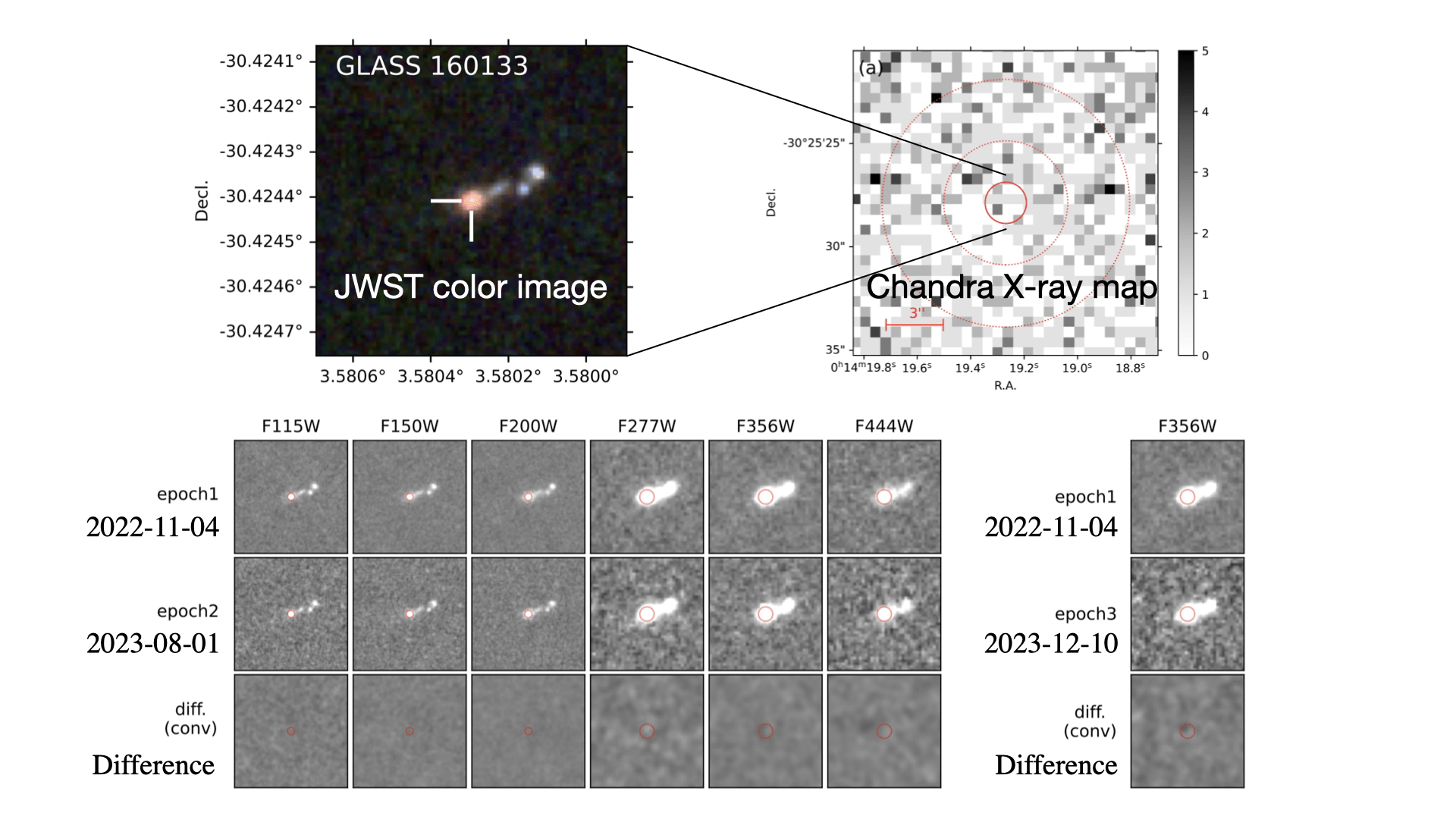
A research team led by Dr. Mitsuru Kokubo (NAOJ Fellow, National Astronomical Observatory of Japan) and Dr. Yuichi Harikane (Assistant Professor, Institute for Cosmic Ray Research, The University of Tokyo) set out to test the AGN hypothesis directly. By combining multi-epoch JWST/NIRCam imaging with extremely deep Chandra X-ray observations, they searched for key observational signatures that must be present if these sources indeed harbor AGNs. Specifically, AGNs typically show rapid ultraviolet–optical variability originating from the accretion disk, as well as strong X-ray emission from the innermost disk regions.
Surprisingly, the analysis revealed no detectable variability in the rest-UV to optical wavelengths for any of the five broad-Hα objects studied. Moreover, none of the sources showed the X-ray emission that is universally observed in standard AGNs.
These results indicate that the observed objects differ fundamentally from ordinary AGNs. Their properties cannot be explained by conventional AGN models, suggesting that alternative physical mechanisms may be responsible. The authors propose several non-AGN scenarios, including high-velocity gas flows generated by intense star formation, or radiative transfer effects in which stellar ultraviolet light is scattered by surrounding hydrogen gas, producing an apparent high-velocity Hα component.
The findings imply that our current understanding of the relationship between supermassive black hole growth and galaxy evolution in the early universe—and the prevalence of AGNs at high redshift—may need to be significantly revised. Future work, including more detailed spectroscopy, multi-wavelength follow-up observations, and improved theoretical modeling, will be crucial for uncovering the true nature of these enigmatic early-universe objects.
Paper Information
Title: Challenging the Active Galactic Nucleus Scenario for JWST/NIRSpec Little Red Dot and Non-Little Red Dot Broad Hα Emitters in Light of Nondetection of NIRCam Photometric Variability and X-Ray
Authors: Mitsuru Kokubo, Yuichi Harikane
Journal: The Astrophysical Journal
DOI: 10.3847/1538-4357/ae119e
URL: https://iopscience.iop.org/article/10.3847/1538-4357/ae119e