Division of Science, NAOJ
Solving the Mystery of a “Too-Light” Neutron Star: Revisiting the Mass of SMC X-1
Contents:
Neutron stars are among the densest objects in the Universe, and determining how light a neutron star can be is crucial for understanding the physics of supernova explosions and compact-object formation. The X-ray binary SMC X-1, located in the Small Magellanic Cloud, has long attracted attention because its neutron star mass was estimated to be only about 1.1 times that of the Sun, placing it close to the theoretically expected lower limit for neutron stars.
Masses of neutron stars in binary systems are usually determined by measuring how strongly their gravity causes the companion star to move. In SMC X-1, however, the companion star is exposed to intense X-ray irradiation from the neutron star, raising the possibility that conventional mass measurements may be biased.
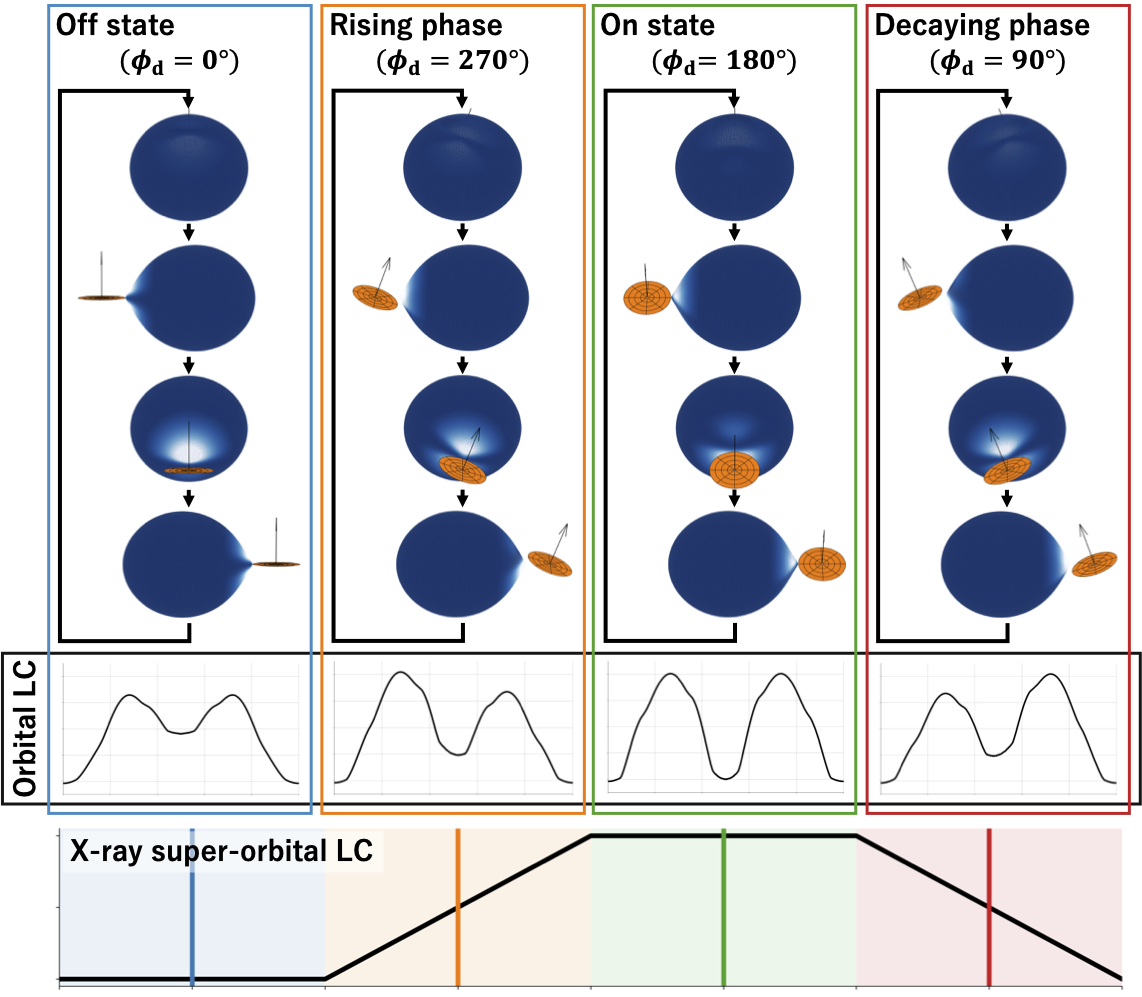
A research team led by Masafumi Niwano of the National Astronomical Observatory of Japan analyzed high-precision optical observations from NASA’s Transiting Exoplanet Survey Satellite (TESS) together with X-ray data from the Monitor of All-sky X-ray Image (MAXI) aboard the International Space Station. The team discovered that variations in the optical light curve are closely linked to the system’s long-term X-ray variability, which repeats every 40–60 days.
To explain this behavior, the researchers developed a model in which a precessing accretion disk changes the pattern of X-ray illumination on the companion star. The model successfully reproduces both the observed optical and X-ray variations, providing new observational support for the long-standing picture that the super-orbital variability of SMC X-1 is driven by a precessing accretion disk.
The analysis further revealed that the intense X-ray irradiation significantly distorts the apparent brightness distribution across the companion star. As a result, the measured orbital velocity of the companion may be underestimated by approximately 20%. Correcting for this effect increases the estimated neutron star mass from about 1.1 solar masses to approximately 1.35 solar masses, bringing it much closer to the typical masses observed for neutron stars.
These findings suggest that SMC X-1 may not host an unusually low-mass neutron star after all. More broadly, the study highlights the importance of accounting for irradiation effects when measuring masses in X-ray binaries and provides new insights into the formation and evolution of neutron stars.
Information:
Title: Optical super-orbital modulation of SMC X-1: Disk precession and a revised pulsar mass
Authors: Masafumi Niwano, Nobuyuki Kawai, Michael Fausnaugh
Journal: Publications of the Astronomical Society of Japan
DOI:10.1093/pasj/psag069