国立天文台科学研究部
Gamma-Ray Burst Light Curve Reconstruction: A Comparative Machine and Deep Learning Analysis
Gamma-Ray Bursts (GRBs) are the most powerful explosions in the universe, detectable from large distances and useful for measuring cosmic expansion. Their utility is based on correlations like the Dainotti relation, which connects a GRB’s afterglow luminosity with its duration. Challenges in data collection from observatories such as the Neil Gehrels Swift Observatory arise from incomplete data and temporal gaps caused by instrumental issues. This research [1] proposes a machine learning approach for Light Curve Reconstruction (LCR) to fill in these gaps, continuing previous efforts by some of us [2] in improving the accuracy of key parameters: log Ta (end time of plateau emission), log Fa (flux at the end of the plateau), and alpha (decay slope of the light curve after the plateau).
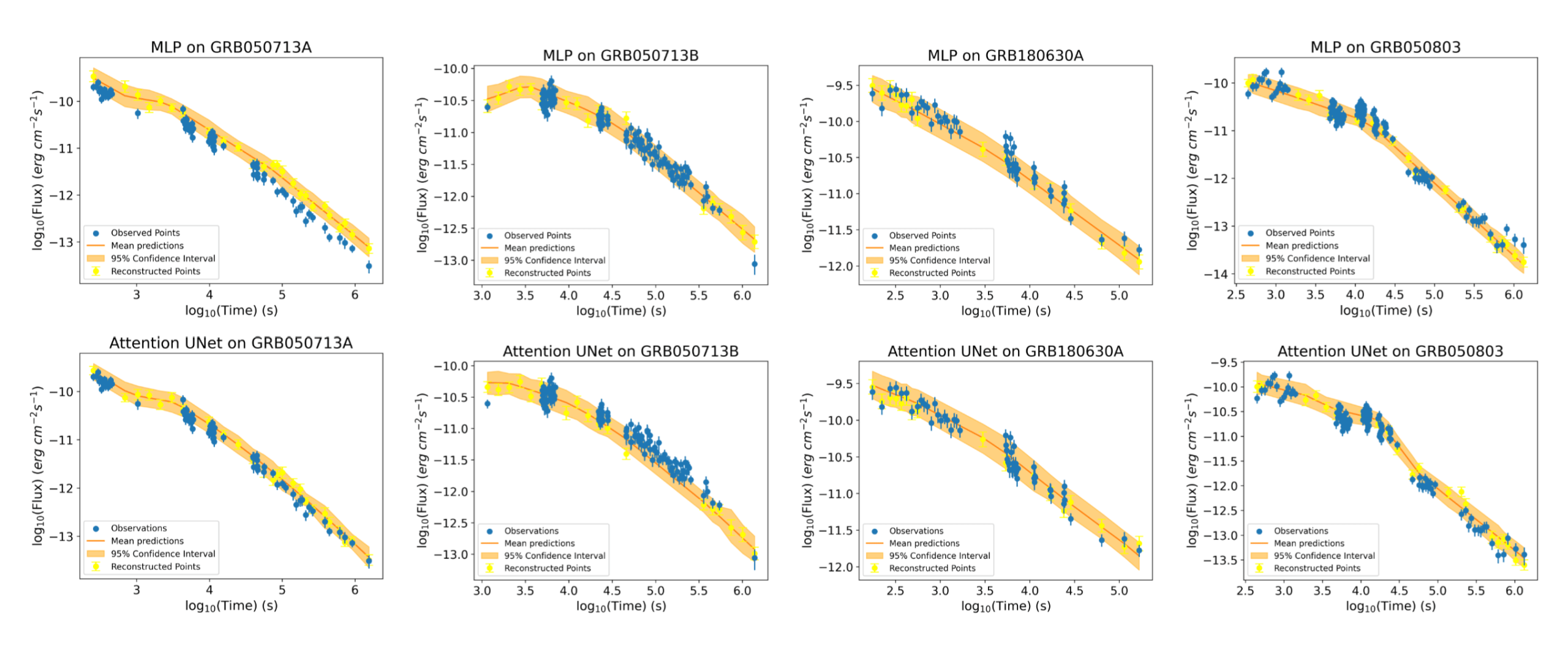
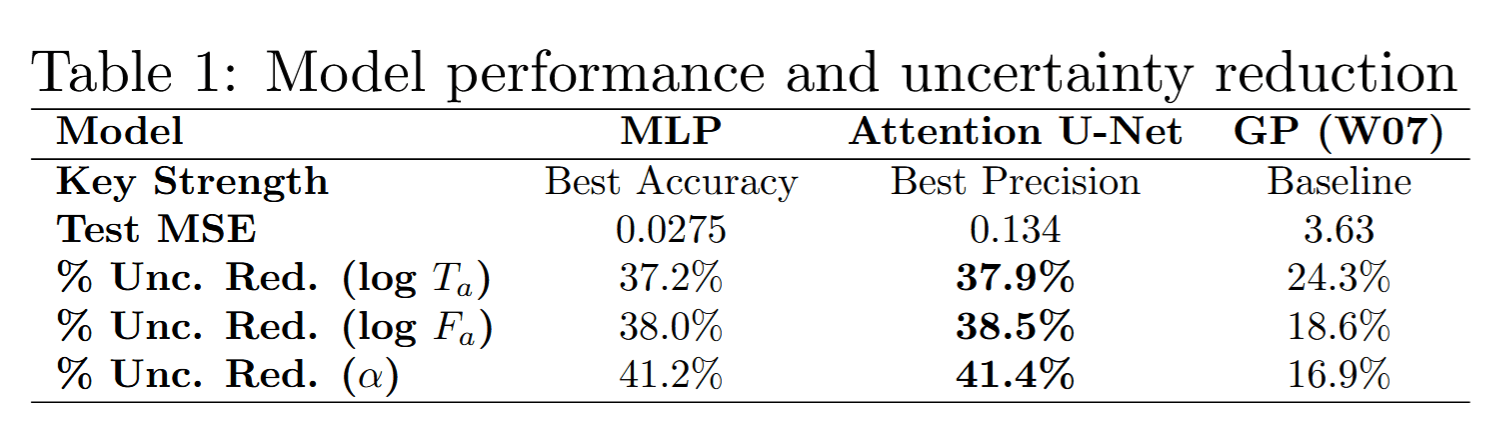
The research team analyzed a dataset of 521 Gamma-Ray Bursts (GRBs) from the Swift BAT-XRT repository, testing nine machine learning (ML) and deep learning (DL) models against the standard Willingale (W07) model. The models evaluated included Multi-Layer Perceptron (MLP), Attention U-Net, Bi-Mamba, Bidirectional Long Short-Term Memory (Bi-LSTM), Kolmogorov-Arnold Networks (KANs), Conditional GAN (CGAN), Gaussian Process–Random Forest Hybrid (GP-RF), SARIMAX-based Kalman Filter, and Fourier Transform. They were assessed based on accuracy, measured by the lowest 5-fold cross-validation Mean Squared Error (MSE), and precision, determined by the reduction in uncertainty of parameters log Ta, log Fa, and alpha. The MLP and Attention U-Net models were identified as the top performers as shown in the model performance table. Additionally, the reconstruction figure shows the reconstructions produced by the MLP and the Attention U-Net models.
This study, published in November 2025 in The Astrophysical Journal, introduces a validated toolkit for the astrophysics community with several implications.
For Cosmology: The study enhances the Dainotti relation by decreasing uncertainties in log Ta and log Fa by over 38 percent, improving the use of GRBs as standard candles for measuring the expansion of the universe.
For Astrophysics: The reduction of uncertainty in the post-plateau slope, alpha, by more than 41 percent allows more rigorous testing of GRB theoretical models such as the fireball model.
For Future Missions: This framework is adaptable for analyzing data from future missions like SVOM, Einstein Probe, and THESEUS, extending its applicability across data from various wavelengths.
References:
[1] Manchanda, A., Kaushal, A., Dainotti, M. G., Gupta, K., Deepu, A., Naqi, S., Felix, J., Indoriya, N., Magesh, S. P., Gupta, H., et al., 2025, ApJS, 281(2), 35.
[2] Dainotti, M. G., Sharma, R., Narendra, A., et al., 2023, ApJS, 267(2), 42.